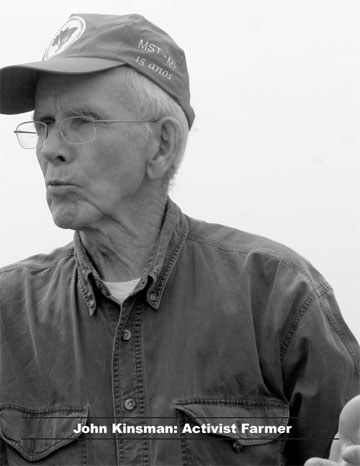
Last fall I interviewed John Kinsman of the Family Farm Defenders in a live talk-show type format at the Jane Addams Hull House Museum (check out the video here or listen to a recording from WBEZ). The interview is posted below and the booklet made of that interview along with other articles by and about John that I produced for FFD to use as a fundraiser is available here for download: kinsman booklet-final-singlepage-web. Thanks to Irina Contreras for the transcription.
John Kinsman Interview
Conducted live by Daniel Tucker at the Jane Addams Hull House Museum (Chicago, IL) on September 27th, 2011
Daniel Tucker (DT): Your parents farmed during the Great Depression. You have said it was easier for farmers then than it is for farmers now. Why is that?
John Kinsman (JK): At that time, we were diversified farmers. We had cows, pigs and chickens. We raised wheat, oats and barley. And when we didn’t have enough money to buy wonderful white bread, sliced white bread, my god we had to eat wheat bread, we took it to the mill and ground it, hated it and now we love it. And we are looking for it all over. So that is part of how we lived but it was not a problem. And it was a leisurely life, believe it or not. We never worked on Sunday. Nobody in the family had to work out [off farm] to support the farm. A farm now is almost a hobby for some people. The man and the woman have to get a job to support their hobby. My parents were able to go to the world’s fair Chicago in 1933 and this is during the Depression. And I remember my grandmother came and took care of us. I forgot how old I was but not old enough to run the farm. And they did that, my grandparents went to California. And I have a picture of that, my grandma with goggles on, she and Grandpa went on a flight in an open cockpit plane in California and so on. Well, anyway it was a more leisurely time. We ate berries everyday so we picked berries. Wild berries and a few tame ones. I remember the gooseberries especially because they were prickly. And my mother canned them. And now we know that berries are very healthy. But, we had berries for almost twice a day and we ate them fresh or canned. And so, it was a good life in spite of the so-called Depression.
DT: You’ve said that you agree with a recent UN report saying “supporting low carbon and resource preserving small holder farms” is the only kind of agriculture that will cool the planet – in reference to global warming. You have farmed organically since the 60’s but you didn’t always. Can you talk about your transition to organic farming and what you have learned from this approach to agriculture?
JK: Certainly. The UW Madison, the College of Agriculture was the best friend of my father and myself. And as time went on, it was like things were changing. We were getting into technology that we had questions about but we thought we had to do it. You know the story of the frog? You put the frog in water and you turn up the heat a little bit and a little bit more and pretty soon the frog is boiled and it doesn’t even jump out. And this happened to us. And I started using herbicides thinking “well, this will save me a lot of time”. And I ended up in the University Hospital with some serious burns. They would never say what it was because of the research going on. But the doctors said, “What’s your name? What’s your occupation?” “Farmer.” “When was the last time you used herbicides or pesticides?” And the same with the med students who examined me. Same thing, exactly. So I knew what it was and yet there wasn’t ever anything in the records that said what it was.
DT: And these were herbicides that they had given you? Is that right?
JK: This was what they promoted at the University and then we started looking…and I became organic overnight. That was almost 50 years ago. And I was in that direction but we were led away from it by the research. We didn’t know that these chemical companies were funding the research and the rest so we did a FOIA search one time and found out a lot of things . . .
DT: So can you say a little bit more, just give us a sense of what your farm is like and what your farming practices are like?
JK: My passion is tree planting and farming. Because I am a sustainable tree farmer and my family have planted over a 100,000 trees, but we have no place to plant anymore because every inch that there could be planted a tree is planted already. So, it’s just a joy to see what that does to the environment and becomes the most valuable part of what could have been cleared and so on. That’s part of it. What was the rest of the question?
DT: And tell us a little bit about your dairy operation.
JK: Okay. We have 36 cows; maintain that number and it’s an intensive rotational grazing. My cows get fresh pasture, green grass and clover every 12 hours. And if they don’t get it, they complain. So, but they spread the manure, they spread the fertilizer and they carry the milk in and they carry the fertilizer out. So we have a very low carbon footprint. Many farmers, especially the factory farms think I am not a farmer. In fact, the UW College of Agriculture doesn’t consider me a farmer because I am not running the tractor 12/14 hours a day. But, my cows are doing their work. And that’s where the cheese you will have today and so on. It came from my cows.Continue reading “John Kinsman Booklet”
 Daniel Tucker
You must be logged in to post a comment.